
Tracking Aeolus’ historic re-entry
In July 2023, the UK-built Aeolus satellite made history when mission controllers successfully guided its return to Earth. Chilbolton Observatory successfully tracked the satellite during its re-entry, a task no other sensor in the UK could perform.
Chilbolton Observatory’s 25-metre antenna is one of the UK’s leading locations for space situational awareness. Two radars sit behind “the Dish”: the world’s largest fully steerable meteorological radar, the Chilbolton Advanced Meteorological Radar (CAMRa), and the Chilbolton Advanced Satellite Tracking Radar (CASTR). The latter has been in operation since 2010, and the Observatory has provided valuable tracking data to the UK Space Agency’s Space, Surveillance and Tracking team for many years.
In July 2023, the UK-built Aeolus satellite made history when mission controllers successfully guided its return to Earth – the first time such a re-entry manoeuvre has been attempted.
Aeolus took to the skies in 2018 as part of the European Space Agency’s (ESA) Earth Explorer programme. The mission was equipped with state-of-the-art instruments to measure wind profiles from space for the very first time, advancing our understanding of global wind patterns to improve weather forecasting and climate research.
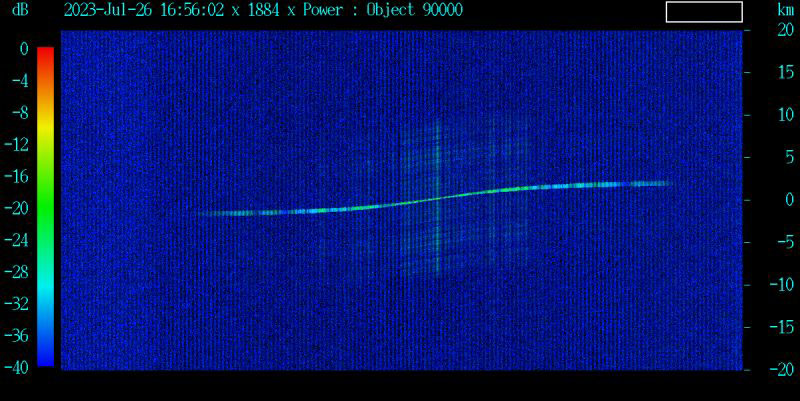
Data from CASTR tracking Aeolus. Credit: STFC RAL Space
The spacecraft was built and launched before regulations were put in place for ‘end of life’ disposal, meaning that there had been no plan to deorbit Aeolus when it was built. However, ESA’s Space Operations Centre in Germany were able to use remaining fuel to steer Aeolus during its return to Earth. This mitigated the already low risk of falling debris causing damage on Earth and provided useful data to inform future satellite re-entries.
Chilbolton Observatory received the request from the UK Space Agency to track Aeolus on 20 July 2023 and worked tirelessly to ensure readiness before Aeolus’ re-entry. From July 26 to 28 they successfully tracked the satellite – a task no other sensor in the UK could perform – during the re-entry process.
Working with the UK Space Agency, the team optimised the data, which were subsequently shared with ESA and the Inter-Agency Debris Committee (IADC). The data also included specific analysis on the risk to UK airspace provided to the Civil Aviation Authority.
Satellites play an important role in many sectors, from Earth observation and climate monitoring to communications. However, with more than 8,000 operational satellites and more than 30,000 pieces of trackable debris in orbit, the ability to operate safely in space is growing increasingly challenging.
The assisted re-entry of Aeolus is a milestone for the space community, proving that this is a feasible way to dispose of end-of-life satellites. Data collected by sensors like CASTR will provide valuable information to analyse the projected final re-entry of these spacecraft.