
Salsa's Last Dance: 24 Years of Cluster mission operations
For over 20 years, a small team within RAL Space has planned and executed science operations for the four Cluster II spacecraft.
Challenge
Understanding space weather – from the auroras to the solar storms that can disrupt satellites, power grids, and communications – requires sustained, detailed study of Earth’s magnetosphere. ESA’s Cluster II mission was designed to do exactly that, but with an original planned lifetime of just two years, keeping four spacecraft scientifically productive and operationally sound for over two decades presented an extraordinary challenge.
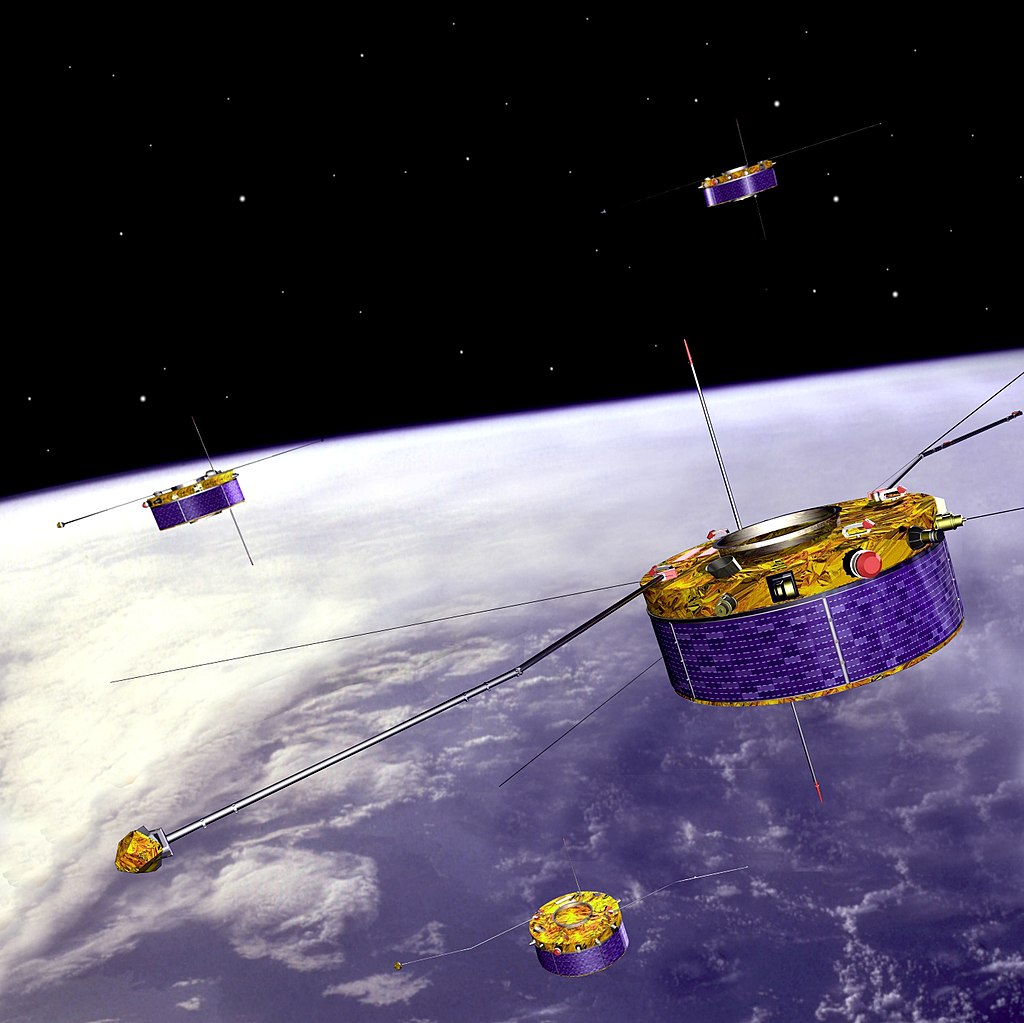
Artist’s impression of the Cluster satellites in space. Credit: ESA
Approach
Throughout the mission’s life, the science operations for all four Cluster II satellites were planned and executed by the Joint Science Operations Centre (JSOC) at RAL Space – one of only a few cases where ESA has contracted this critical responsibility to an external team. Week in, week out, JSOC worked closely with Cluster’s scientific principal investigators and ESA’s spacecraft operations team at the European Space Operations Centre (ESOC) in Germany, translating science goals into the precise commands uplinked to the satellites.
The team navigated significant operational challenges over the years, including spacecraft manoeuvres, solar array eclipses, battery failures, and software issues as orbit and operation counts exceeded expected limits.
Benefits
Cluster II ran for over 24 years – far beyond its intended lifespan – contributing to more than 3,600 scientific publications and transforming understanding of Earth’s magnetosphere and space weather processes. The mission concluded with a world-first targeted re-entry of the first satellite, Salsa, over the South Pacific in September 2024.
JSOC’s contribution has been recognised with multiple awards:
- ESA’s Teamwork Excellence Award (2014)
- The Royal Astronomical Society’s Geophysics Group Achievement Award (2019)
- The Sir Arthur Clarke Award for Space Achievement by an Academic Study/Research Team (2024)
Operations Manager Anne Chadwick reflected: “Many of us at JSOC have spent decades working on the project, so it’s been a big part of our lives for a long time. It hasn’t been without its challenges – running continuous operations around spacecraft manoeuvres, eclipses of the solar arrays by the Earth, the batteries dying, and millennium-type bugs when the numbers of orbits and weeks of operations exceeded three figures! – but we can certainly be proud of our contributions to this fantastic mission.”
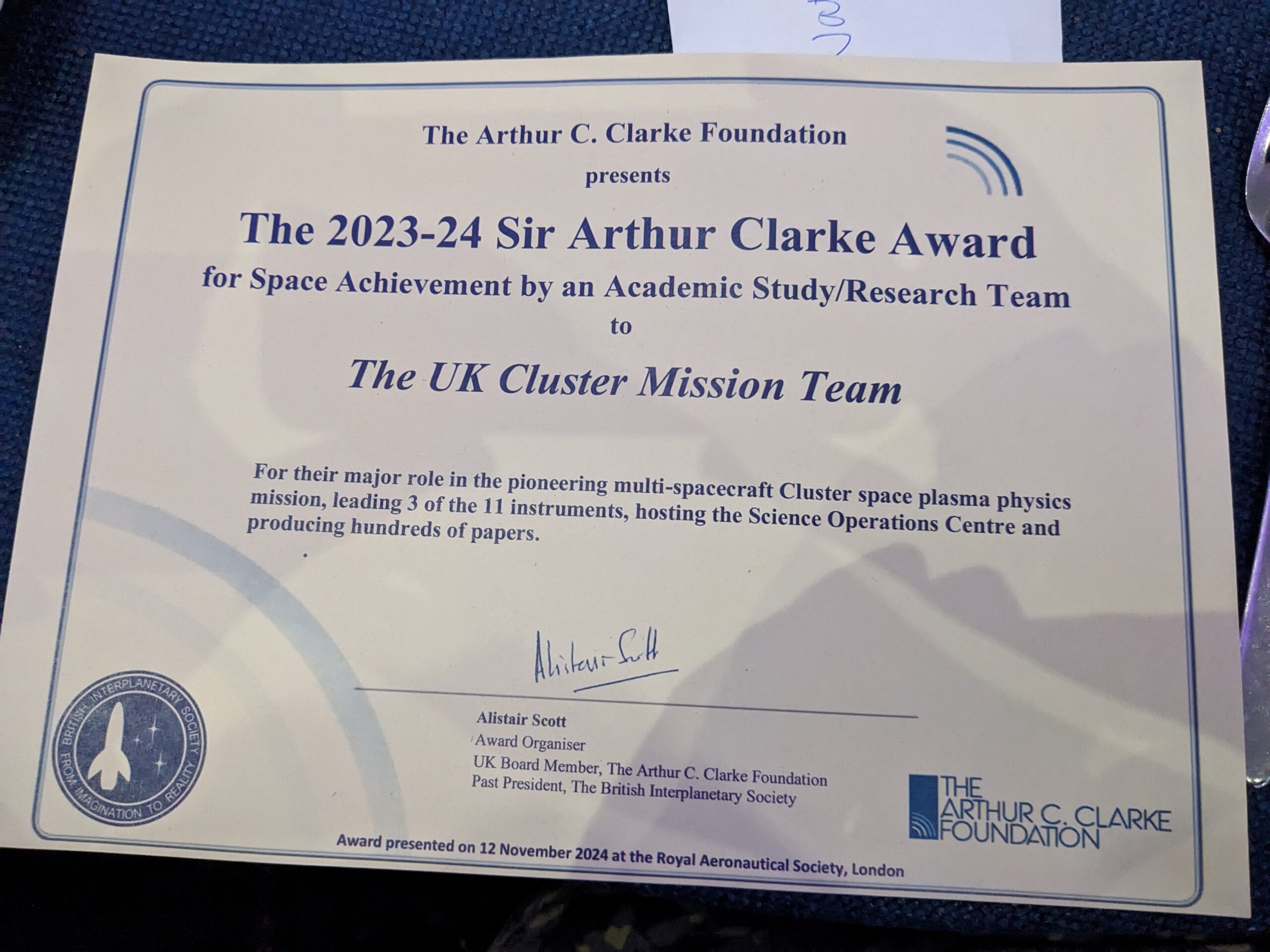
Certificate awarded to the UK Cluster Mission team in 2024.