
WEAVE: A new window on the Universe
RAL Space have co-led a telescope upgrade that will help answer questions about how galaxies form and evolve.
Challenge
Understanding how galaxies form, evolve, and interact requires capturing detailed light spectra from thousands of celestial objects simultaneously – a capability beyond the reach of most existing instruments. Astronomers needed a powerful new tool to study phenomena ranging from dark matter in the Milky Way to violent galaxy collisions billions of light years away.
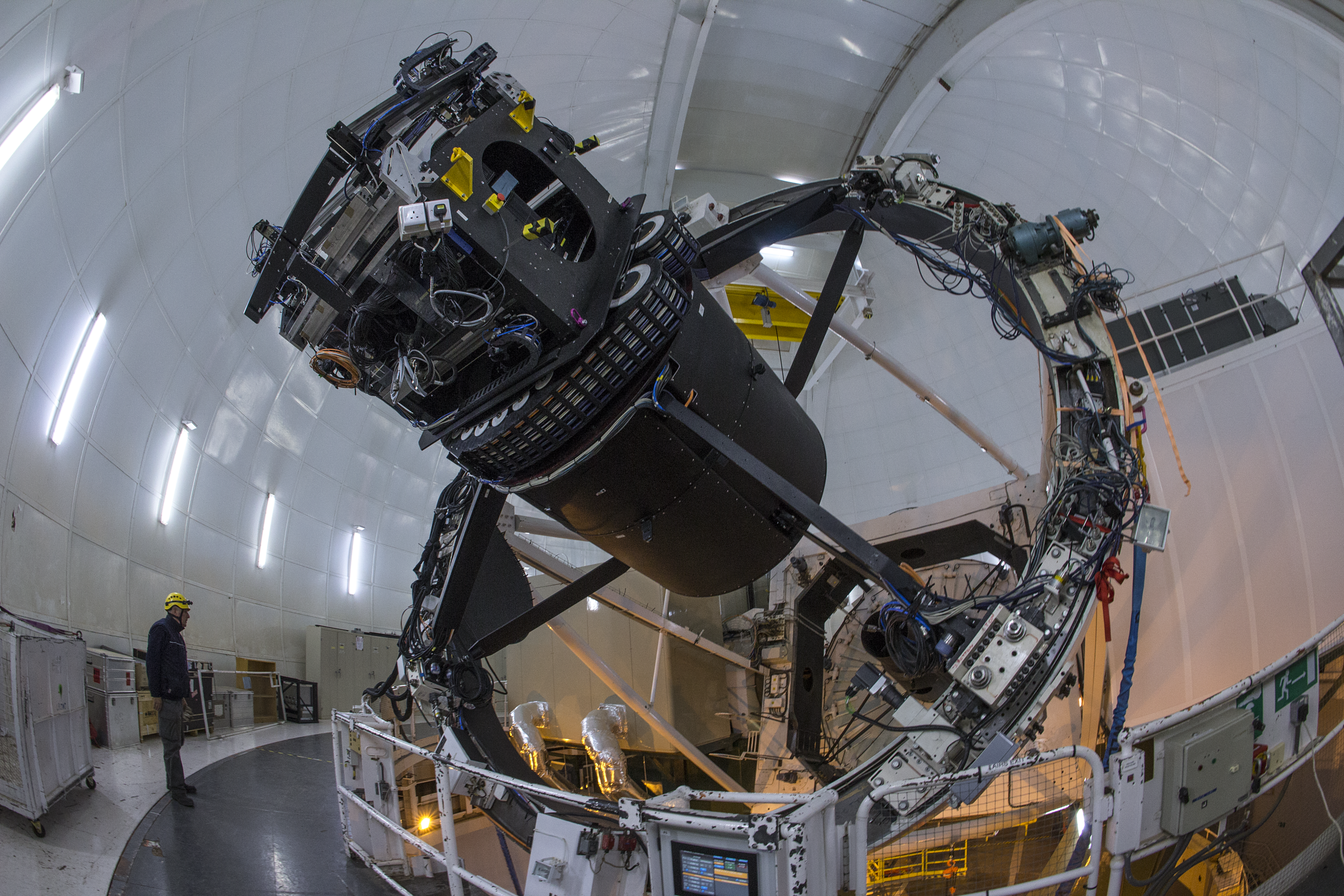
WEAVE installed on the WHT. Credit: Javier Méndez.
Approach
Led by RAL Space and the University of Oxford, a European consortium spent over a decade developing WEAVE – the William Herschel Telescope’s Enhanced Area Velocity Explorer – operated by the Isaac Newton Group of Telescopes in La Palma, Spain. WEAVE captures high-resolution images and analyses light from nearly 1,000 celestial objects simultaneously, offering up to ten times the precision of comparable spectrographs.
Benefits
WEAVE is now operational, with its first science results published in November 2024. These first observations revealed the previously unknown dual nature of the shockwave generated as galaxy NGC 7318b collided with Stephan’s Quintet at over two million miles per hour – behaving differently depending on whether it travels through cold or hot gas. WEAVE is also conducting a 1,200-night survey collecting more than 12 million spectra, mapping dark matter, studying galaxy evolution, and exploring relationships between galaxies and their central black holes.
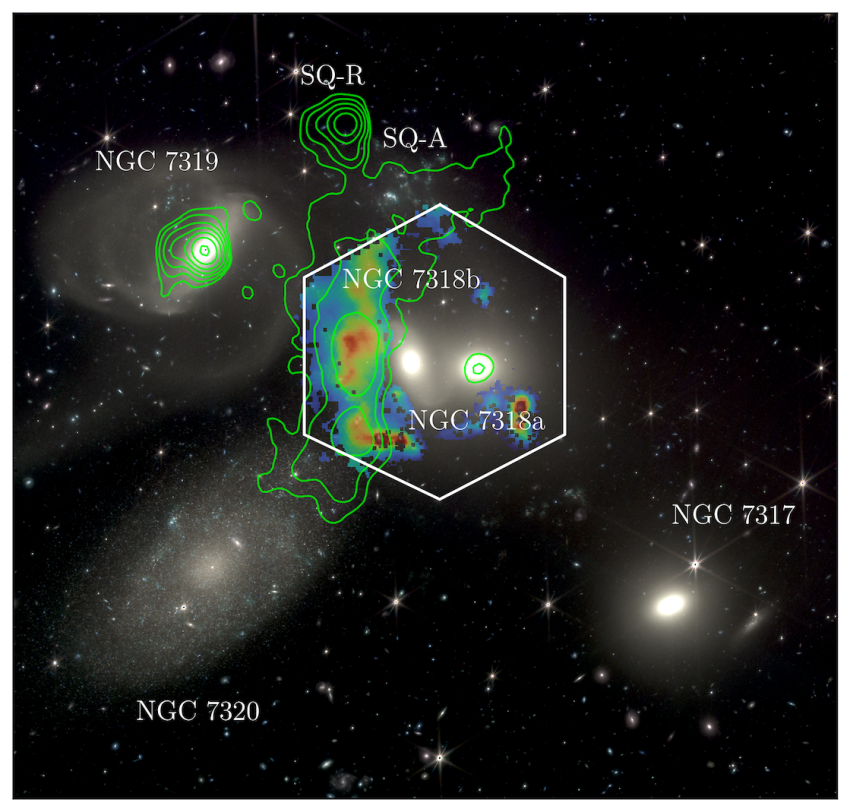
Weave data overlaid on a James Webb Space Telescope image of Stephan’s Quintet, with green contours showing radio data from the Low Frequency Array radio telescope (M. Arnaudova/University of Hertfordshire/WEAVE consortium)