
Blue sky research shaping exploration beyond Earth
RAL Space scientists are investigating how technology could be used to create a man-made magnetosphere around the “Red Planet”.
Challenge
One of the greatest obstacles to long-term human settlement on Mars is its thin, unbreathable atmosphere. Unlike Earth, Mars lacks a global magnetic field to retain its atmosphere and shield inhabitants from dangerous solar radiation and meteorite impacts – making sustained human presence on the surface extremely difficult.
Approach
RAL Space scientists looked at how an artificial, planet-sized magnetosphere could be generated to enable humans to settle on Mars for long stays in the future.
Their research outlines a range of technological innovations, from kick-starting Mars’s core to using stations in orbit to create an artificial magnetic field.
The optimum solution proposed is an artificial charged particle ring around the planet, similar to those found naturally around the Earth. This could be formed by ejecting materials from one or both of the Martian moons to form artificial rings around the planet. Particles beamed between space stations in orbit around Mars could drive a net current in the rings to create a magnetic field.
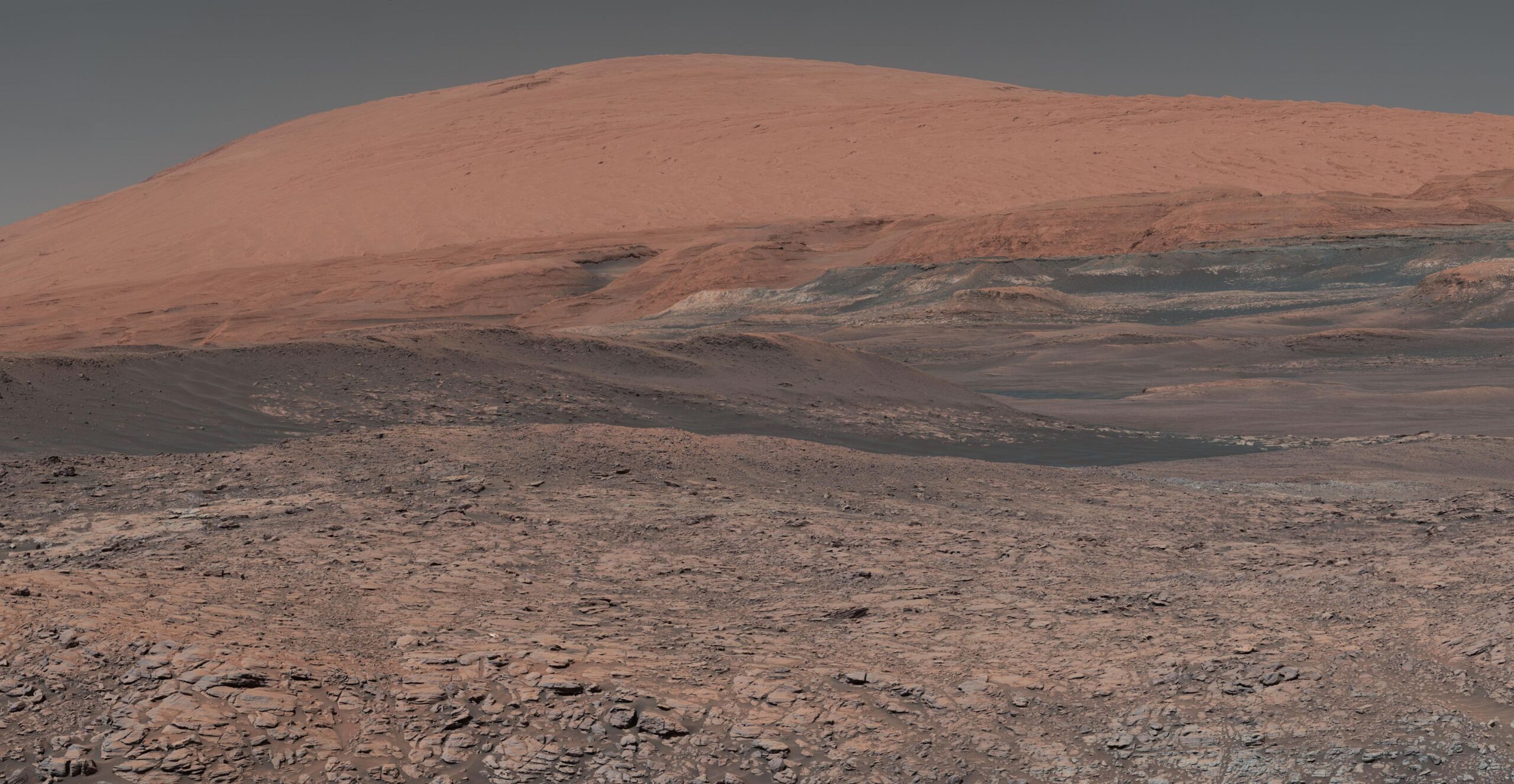
Mount Sharp, Mars, captured by NASA’s Curiosity Rover. Credit: NASA/JPL-Caltech/MSSS
Benefits
This cutting-edge research represents the first exploration of the practical and engineering methods that could be used to solve one of the biggest problems facing a long-term human presence on Mars. While we are a long way away from developing the technology needed, RAL Space scientists are pioneering the concepts and bringing them to the forefront of international scientific discussion.