
LIRA: Monitoring Carbon Capture in Iceland
The Spectroscopy Group at RAL Space has developed a powerful tool for tracking carbon capture efficiency in real time, enabling data required to optimise storage technologies at scale.
Challenge
Carbon capture and storage will be essential to reaching net zero, but even renewable energy sources aren’t emissions-free. Reykjavik Energy’s Hellisheiði geothermal power plant in Iceland produces carbon dioxide and hydrogen sulphide as by-products. Their partner Carbfix is pioneering a process that turns these captured gases into rock for permanent underground storage, but optimising that process requires continuous, real-time monitoring of gas concentrations, something traditional laboratory analysis simply can’t provide.
Approach
RAL Space’s Spectroscopy Group developed the Laser Isotope Ratio Analyser (LIRA), a spectrometer capable of measuring sulphur isotope concentrations in hydrogen sulphide in situ and in real time. To test its capabilities, LIRA was installed directly in one of Reykjavik Energy’s turbine halls at Hellisheiði and coupled to an operational turbine. Over two weeks, it took continuous measurements at multiple sampling points, tracking the isotope ratio of hydrogen sulphide as pilot demonstration of the feasibility to use it as a marker characterising the carbon mineralisation process.
The results were validated against traditional laboratory analysis, with a second deployment to a gas injection and monitoring well planned to further extend the instrument’s testing in the field. This work forms part of the Geothermal Emission Control (GECO) project, funded by the European Commission under the H2020 programme and led by Reykjavik Energy.
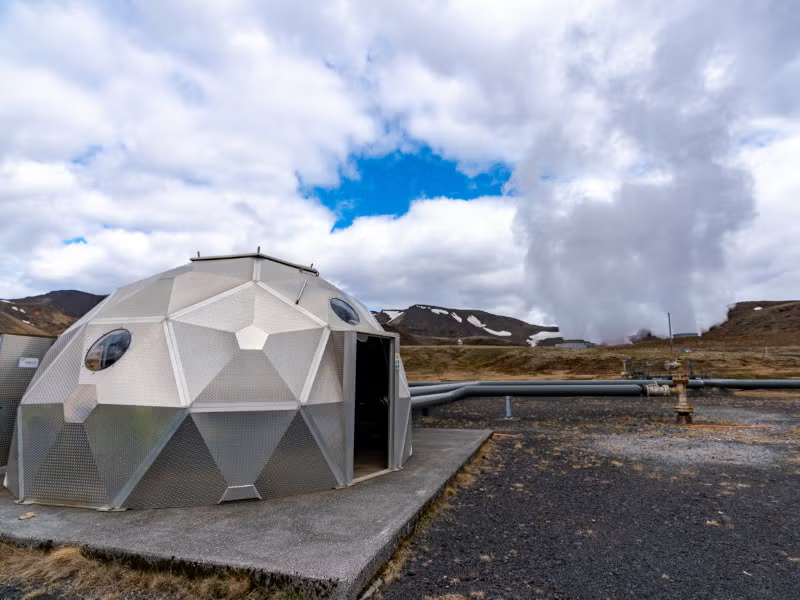
Boreholes and pipes at the Hellisheiði Geothermal Plant. Credit: Ron Przysucha
Benefits
LIRA provides geoscientists with a powerful new tool for tracking carbon capture efficiency in real time – enabling the kind of continuous, in-situ monitoring that is essential for optimising storage technologies at scale. The data gathered at Hellisheiði contributes to understanding the chemistry of gases within injected reservoirs, supporting the development of carbon capture solutions that could be applied across industries worldwide.