
EarthCARE: Unlocking the Climate Secrets of Clouds and Aerosols
The European-Japanese Earth Cloud Aerosol and Radiation Explorer (EarthCARE) mission is shedding new light onto the role that clouds and aerosols play in regulating Earth’s climate.
Challenge
Clouds and aerosols play a crucial role in cooling our atmosphere, but exactly how they interact with incoming solar energy and outgoing heat remained poorly understood. As global temperatures rise, closing this knowledge gap is essential for accurately monitoring climate change and improving the models scientists rely on.
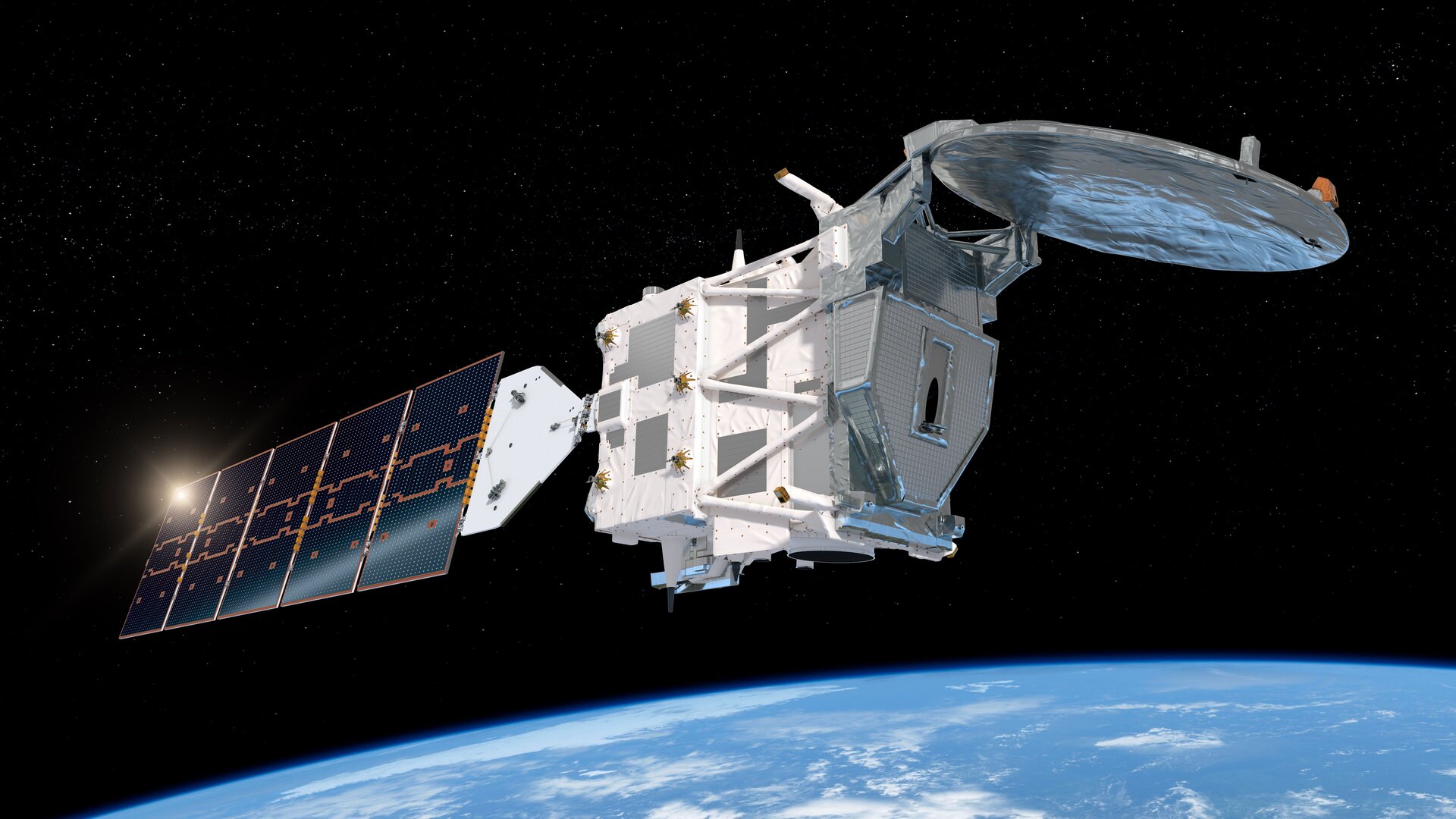
Artist’s impression of EarthCARE in orbit. Credit: ESA/ATG medialab
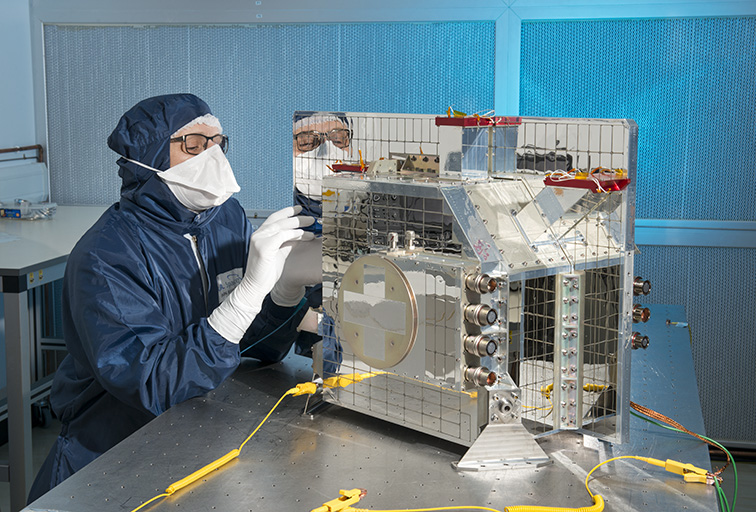
EarthCARE’s Broadband Radiometer
undergoing inspections at RAL Space.
Approach
EarthCARE is a groundbreaking satellite mission jointly developed by the European Space Agency (ESA) and the Japanese Aerospace Exploration Agency (JAXA), equipped with four sophisticated instruments designed to study the relationship between clouds, aerosols, and radiation.
RAL Space’s contribution centred on the Broadband Radiometer (BBR): a unique instrument that observes the atmosphere from three directions simultaneously. Its trio of telescopes captures data from directly below the satellite as well as forward and backward along its flight path, providing a comprehensive picture of Earth’s energy exchange. RAL Space designed and built the intricate telescope assembly and contributed to the instrument’s thermal design, drawing on decades of expertise in climate and weather science instrumentation.
Most of the BBR’s environmental testing and calibration took place at RAL Space facilities, with Thales Alenia Space (UK) leading the instrument’s overall development and test campaign. Following close collaboration between the two teams, BBR was delivered for spacecraft integration in 2018.
Benefits
EarthCARE launched in May 2024 and is delivering remarkable results, with data from all four instruments confirming strong performance. Measurements from BBR will significantly improve scientific understanding of how aerosols, clouds, and radiation interact – data that will advance climate science and support more accurate climate modelling for years to come.