CAITDM: Measuring the Upper Atmosphere for Improved Climate Modelling
RAL Space are developing a quantum sensor system to address data gaps in climate and atmospheric modelling.
Challenge
A significant data gap exists in measuring atmospheric mass density at altitudes between 300 km and 500 km, particularly during periods of heightened solar activity. This limits our ability to accurately model the Earth’s climate and understand energy exchange between the Earth system and solar-wind influences. It also makes it difficult to predict satellite trajectories and re-entry times accurately, posing a growing challenge as demand for low Earth orbit satellites continues to rise. Current measurement techniques rely on electrostatic accelerometers, which suffer from drift caused by voltage reference instability, aging of components, and temperature changes.
Approach
RAL Space, in collaboration with the University of Nottingham and Metamorphic Additive Manufacturing Ltd, developed CAITDM (Cold Atom Interferometer Thermosphere Drag Measurement) – believed to be the most advanced quantum sensor-based system for measuring upper atmosphere density currently in development. Unlike electrostatic accelerometers, CAITDM is drift-free, providing absolute measurements traceable to fundamental constants of nature, with high sensitivity and no need for calibration. The project has progressed through breadboard study, vibration testing, and full physics package assembly, targeting a Technology Readiness Level (TRL) of approximately 4.
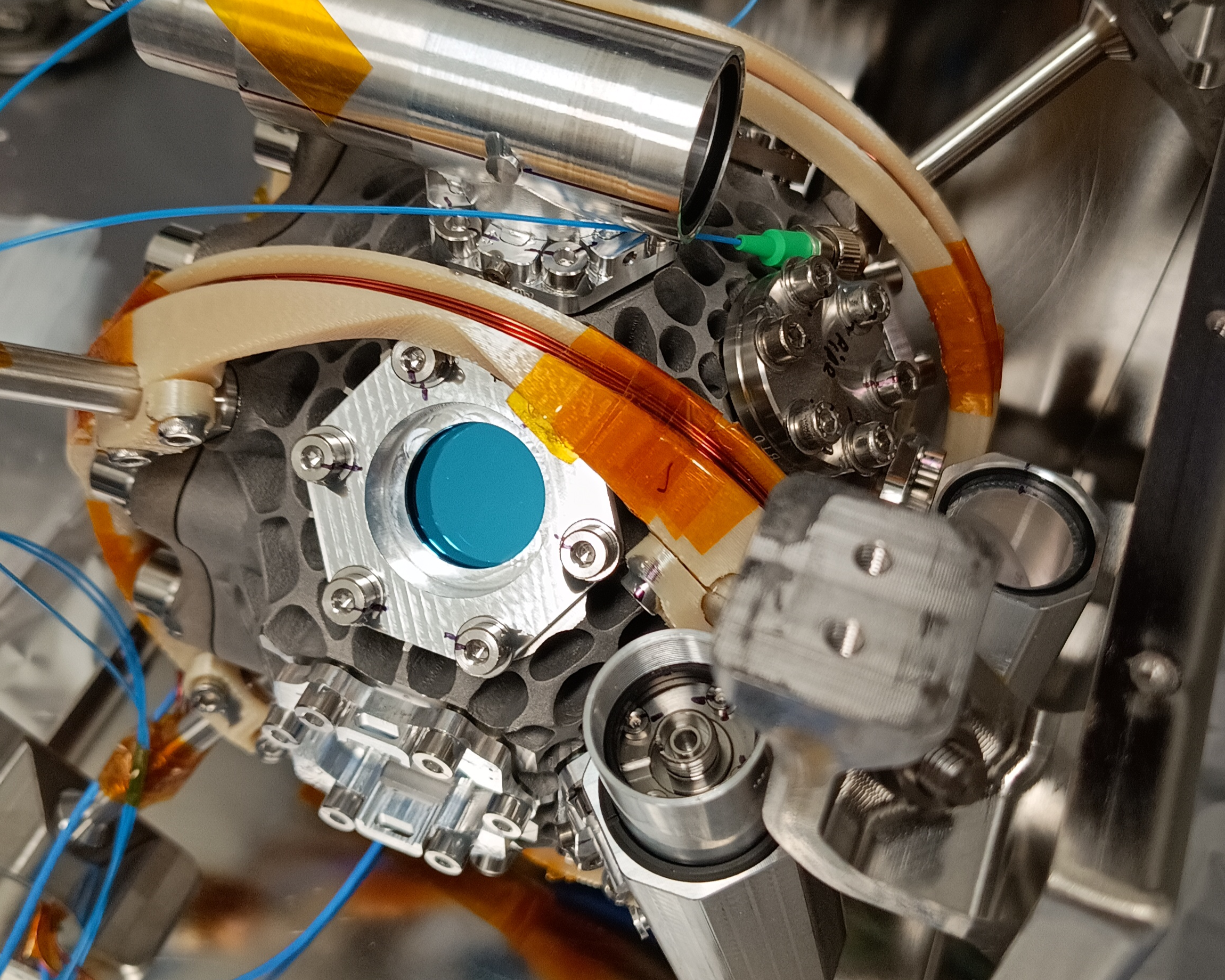
Close up of the CAITDM vacuum chamber and telescopes. Credit: STFC RAL Space
Benefits
CAITDM offers transformative potential across multiple domains. For atmospheric and climate science, it will enable scientists to apply real observational data to existing models, improving accuracy and refining our understanding of energy dynamics in the upper atmosphere. For the space industry, it addresses the drag problem that shortens satellite lifetimes and complicates orbit management – a critical issue as LEO becomes increasingly congested. Beyond its primary mission, CAITDM’s technology can enhance existing ground-based instruments used in geophysics and civil engineering, including monitoring groundwater, detecting sinkholes, and tracking volcanic activity. Longer-term, the platform could support fundamental physics experiments, including tests of general relativity and gravitational wave detection.