
SOLSTICE: A new instrument to plug gaps in climate data
RAL Space is developing SOLSTICE: an miniaturised instrument aiming to plug critical gaps in Earth observation data.
Challenge
Stretching from 8 to 50km above Earth’s surface, the region between the upper troposphere and lower stratosphere is one of the least monitored yet most climate-sensitive regions of our atmosphere. Known as the “canary region”, changes in its chemical composition drive significant shifts in surface temperature and climate. Existing satellite technology observes by looking downward, diluting signals from this zone and failing to capture the fine vertical data scientists need. With no Earth observation mission planned to monitor this region for the next 20–30 years, at a time of accelerating climate change, the data gap is critical.
Approach
RAL Space is developing SOLSTICE: an innovative, miniaturised instrument built on laser heterodyne radiometer technology. The team have built and tested a full payload system and develop flexible flight software, progressing SOLSTICE to its first level of space qualification. A “plug and play” design approach ensures the instrument is commercially scalable and adaptable across multiple platforms and missions. SOLSTICE is now ready for a CubeSat demonstration flight.
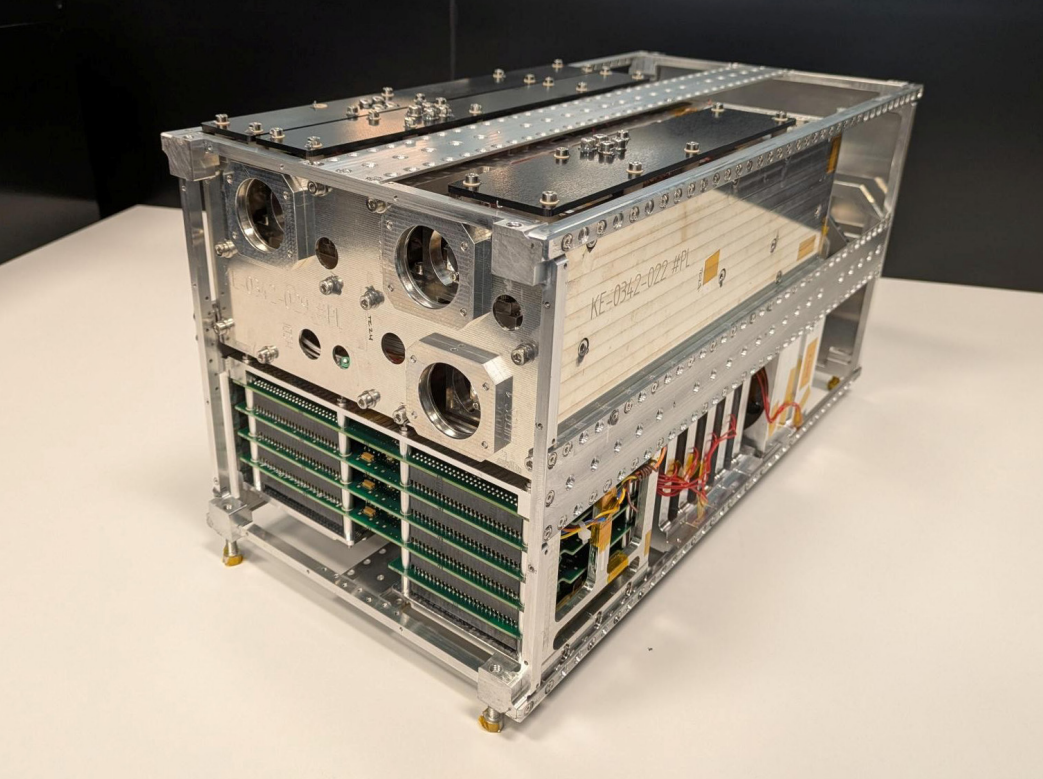
SOLSTICE payload with instruments and flight software control unit, integrated within 16U spacecraft Structural Thermal Model
Benefits
SOLSTICE has the potential to be a genuine game-changer – delivering high-resolution monitoring of the middle atmosphere at around 20 times less cost than traditional systems (previously around £500m). Once operational, it will generate monthly 3D maps of water vapour, ozone, aerosols and greenhouse gases, supporting climate modelling, emissions estimation and ozone recovery monitoring. The dataset will also train AI and digital twinning models to improve weather prediction.