
SpeQtre: A new approach to space technology
RAL Space is leading the UK’s role in a cubesat mission testing ‘unhackable’ quantum technology, paving the way for secure data in a future shaped by quantum computing.
Challenge
Space and quantum represent two vastly different frontiers – one reaching beyond our planet, the other delving into the tiniest concepts imaginable. Both sectors demand pioneering science and engineering at the very limits of what’s possible, and although combining them might sound like science fiction, this fusion might soon be essential to our digital security
Quantum computing promises exciting breakthroughs in many fields, but it also poses a threat to current cybersecurity. Today’s encryption methods will eventually become vulnerable to hacking by these advanced computers. But quantum technology also offers a possible solution. Encryption keys formed using quantum randomness are theoretically unhackable by any computational means.
Deploying this technology in space amplifies the difficulty of an already complex feat. However, it is crucial for enabling communication over long distances, creating powerful impacts on everyday lives and the economy.
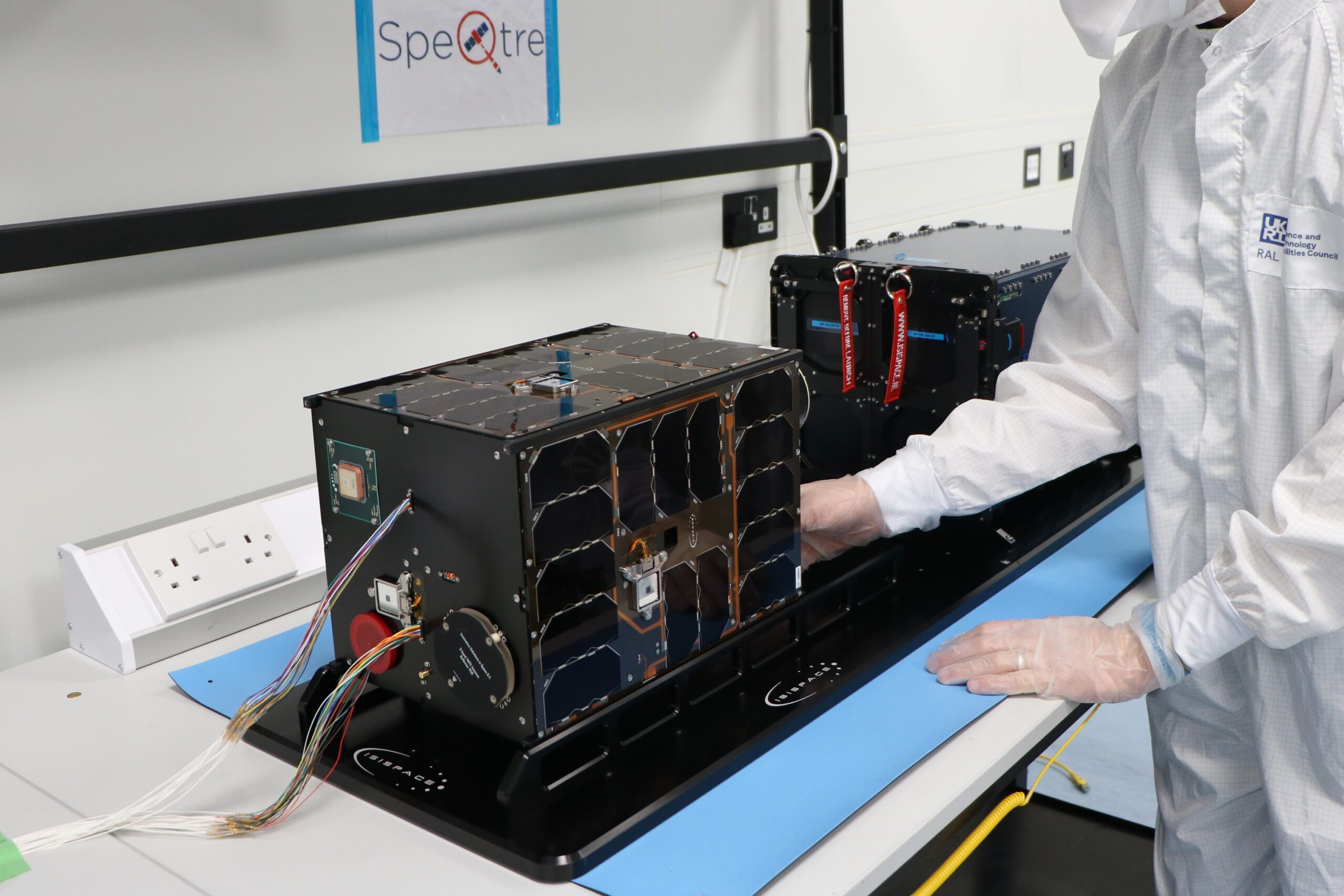
SpeQtre undergoing final preparations at RAL Space before being shipped for launch. Credit: STFC RAL Space
Approach
The UK and Singapore are collaborating on SpeQtre – an in-orbit demonstration satellite that takes a radically different approach from conventional space missions. Rather than following the lengthy, risk-averse processes typical of many space projects, the SpeQtre team has embraced experimentation and speed.
The project combines off-the-shelf components with cutting-edge technology through an experimental development process that accepts calculated risk. This approach has enabled the satellite to progress from concept to being ready for launch more quickly and at lower cost than comparable missions, whilst still meeting technical standards.
RAL Space has led the UK’s contribution, overseeing the space components and developing the optical instrument that beams quantum signals back to Earth, whilst Singaporean quantum communications company SpeQtral has provided the quantum hardware.
Benefits
Crucially, SpeQtre aims to demonstrate this technology from a cubesat roughly the size of a microwave oven – a notably more difficult technical challenge than using larger satellites. By proving that quantum communications can work from such a compact platform, the project could make future systems more accessible and affordable.
The satellite launched in November 2025 and is already informing future projects. Following commissioning, quantum experiments will begin, exchanging quantum information between RAL Space’s ground station at Chilbolton Observatory and a corresponding facility at the National University of Singapore.

Artist’s impression of SpeQtre in space. Credit: ISISPACE