
Tuning into the Eclipse: How the UK public helped researchers “hear” the 1999 solar eclipse
11 Aug 2026
When the Moon’s shadow swept across the UK during the 1999 total solar eclipse, scientists saw an opportunity. With help from hundreds of volunteers, they turned the event into a nationwide experiment revealing how eclipses affect the way radio waves travel through our atmosphere.

On 11 August 1999, parts of the UK were plunged into darkness as the first total solar eclipse visible from UK mainland in 72 years extended across the country. Totality was confined mainly to Cornwall, but the eclipse’s shadow stretched far beyond, capturing the attention of thousands.
Scientists were among those preparing for the event – not just to witness it, but to utilise it.
“It isn’t immediately obvious that a solar eclipse would influence radio reception,” explains Dr Ruth Bamford, an experimental plasma physics researcher at RAL Space, who led the project. “But we already knew that certain radio frequencies behave differently at night. That’s because the ionosphere changes when sunlight disappears. An eclipse is a short-lived version of that.”
The opportunity
The ionosphere – a region of Earth’s atmosphere charged by solar radiation – plays a crucial role in how radio waves travel. During the night, when the Sun’s influence weakens, radio signals can travel much farther. A total eclipse offered a rare chance to observe similar effects in broad daylight.
“We realised we could turn the eclipse into an ionospheric experiment”, says Dr Bamford. “The frequencies most affected would be ones people could pick up on ordinary radios. That’s when we thought: let’s involve the public.”
The team designed a project with two goals: to raise the public’s awareness of radio science, and to gather data on how the eclipse altered radio propagation across the UK.

"The frequencies most affected would be ones people could pick up on ordinary radios. That's when we thought: let's involve the public."
The experiment
“The experiment itself was wonderfully simple,” says Dr Bamford. “We asked people to tune their radios to a specific continental station and tell us whether they could hear it as the eclipse passed.”
Volunteers were asked to listen for Radio La Coruña, a Spanish station normally inaudible on household radios during the day. Participants then posted their observations to RAL, noting whether they heard the signal and where in the UK they were located.
As the eclipse moved across the UK, hundreds of listeners reported the station fading in and out – a clear indicator that radio waves were travelling farther than usual.
“It was exactly what we hoped to see,” says Dr Bamford. “The eclipse created conditions similar to night-time, allowing the signal to reach much farther.”
Just as importantly, the experiment was accessible to almost everyone.
“It didn’t matter if it was cloudy, or if someone couldn’t see the eclipse at all,” she adds. “People could still take part. That meant we could bring this phenomenon to far more people than a traditional observing event.”
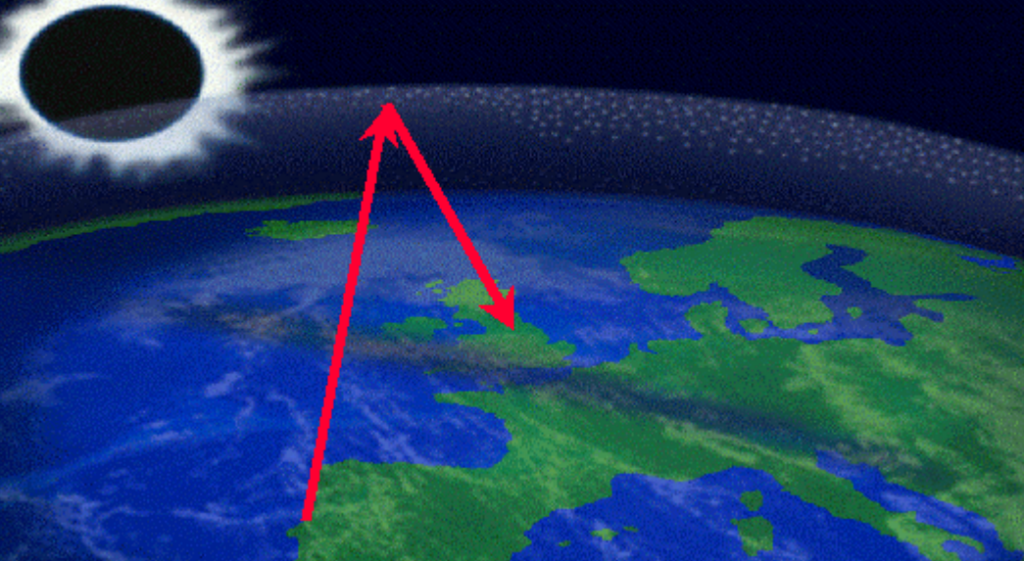
An example of the graphics used to promote the experiment with the public. The animated version of this graphic was used by Sky News.
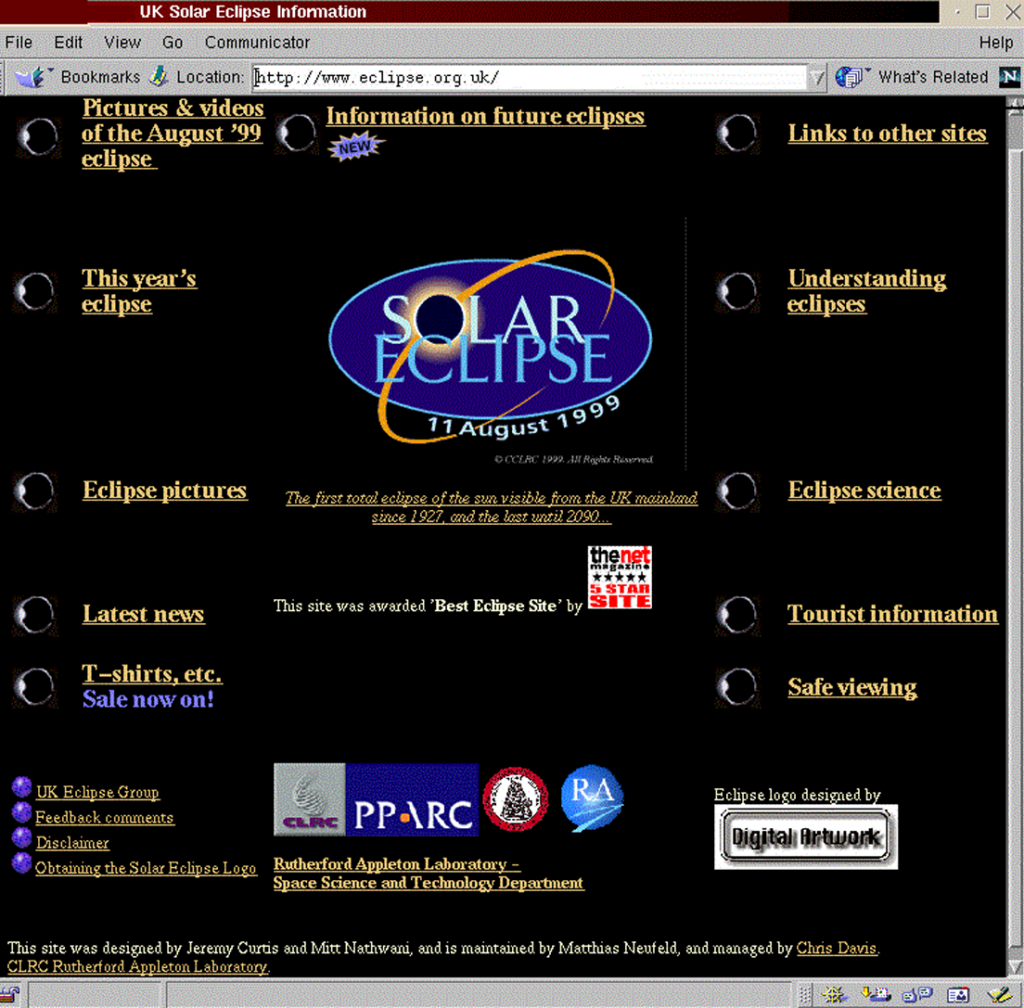
A screengrab from the UK Eclipse website as it appeared in 1999.
The response
The project received around 1700 responses, boosted by a strong publicity campaign and widespread media interest.
One of the most effective tools was the project’s dedicated website, which provided instructions, background science, and a way for the public to engage ahead of the event.
The experiment also attracted significant media coverage. On the day of the eclipse, The Daily Telegraph published a coupon for readers to complete and post to RAL, and the project featured in 12 television interviews, 15 radio broadcasts and 22 print articles.
The impact
The radio eclipse experiment proved to be a major success – both as a public engagement activity and as a scientific study. The team gained a large, diverse dataset of radio observations, offering valuable insight into how the ionosphere responds to sudden changes in solar radiation.
“We definitely achieved our objectives,” says Dr Bamford. “The public were absolutely central to the experiment. We couldn’t have done it without them. And the level of media interest was fantastic to see. It just shows how powerful these shared scientific moments can be.”
The full report, Radio and the 1999 UK Total Solar Eclipse, can be found here.
"The public were absolutely central to the experiment. We couldn't have done it without them."
Preparations for the 2026 Eclipse
Although the Moon won’t cover quite as much of the Sun from the UK in 2026 – the next total eclipse visible from here won’t arrive until 2090 – the event still offers valuable opportunities for researchers. Even a partial eclipse makes the Sun’s outer atmosphere, normally hidden by the glare of the solar surface, easier to observe.
It also provides a chance to engage the public once again.
At RAL Space, Simon Blackshaw, an early-career Millimetre Wave Engineer, has been working with STFC’s Public Engagement team to hold a hybrid event celebrating the eclipse.
Simon realised that the RSS Sir David Attenborough would be close to the path of totality, and reached out to the British Antarctic Survey to explore a collaboration. The result is a joint event linking audiences at RAL with researchers aboard the ship as they experience their moment of maximum eclipse.
The in‑person event at RAL will accommodate over 200 people, but demand has been far higher, with more than 1,000 people entering the ticket lottery. To make the event more inclusive, the team will also host an online webinar, allowing people across the UK to take part whether or not they can see the eclipse themselves.
The programme will begin with a short introduction to eclipses and solar physics from Professor Richard Harrison, followed by a live link to the RRS Sir David Attenborough as they experience the totality. For those attending in person, there will be safe solar viewing and hands-on activities – ensuring plenty to experience, whatever the weather. The event builds on STFC’s wider programme of inclusive public engagement, designed to reduce barriers to participation and strengthen links with communities, including those in areas of higher deprivation.
“It has been a great experience to see this event come to life, from what started as a small idea into a collaboration across the ocean,” says Simon. “Having the opportunity to hold events like this allows us to celebrate real science with real people. These events can highlight physics at work which is not always visible but has a great impact on our day to day lives.
Being a part of the STFC PE programme allows early career scientists and engineers such as myself to develop a different skillset to the norm of the laboratory. Having the opportunity to lead or contribute to a real project making a difference to other people is invaluable.”
Spaces for the in‑person event are now fully booked, but you can still register to join the webinar online: https://ONLINE-summer_stargazing.eventbrite.co.uk
“Having the opportunity to hold events like this allows us to celebrate real science with real people. These events can highlight physics at work which is not always visible but has a great impact on our day to day lives."