STEREO at 20: A mission that changed our view of the Sun
26 Oct 2026
20 years after its launch on 26 October 2006 (UK time), the groundbreaking STEREO mission is still shaping solar science and providing key data for operational space weather forecasting.

A New View of Our Star
NASA’s Solar Terrestrial Relations Observatory (STEREO) originally consisted of two near-identical spacecraft placed ahead of and behind Earth’s orbital path.
Their separation from each other and from Earth opened up a new perspective of the Sun. For the first time, we could see the entire surface of the Sun, and map its violent outbursts – known as coronal mass ejections (CMEs) – in three dimensions.
“CMEs are one of the main drivers of what we call space weather,” explains Dr Jackie Davies, Heliospheric Physics Lead at RAL Space. “Understanding their size, speed, and direction helps us protect infrastructure at risk of damage from the impacts of space weather. That includes satellites, communications systems, and power grids.”
Severe space weather has been recognised on the UK’s National Risk Register since 2011, and the Met Office Space Weather Operations Centre (MOSWOC) is one of several 24/7 space weather prediction centres around the globe.
The Heliospheric Imagers
When Professor Richard Harrison retired in 2023, Dr Davies became Principal Investigator for STEREO’s Heliospheric Imager (HI) instruments – one of which is still operational today.
Developed by a consortium led by RAL Space, the HIs observe the space between the Sun and the Earth, enabling clearer views of CMEs travelling towards the Earth, and improving our ability to identify and monitor events that might have an impact.
It turned out they could capture more than CMEs, too.
“In the first months alone, we saw far of the Moon, several asteroids, and an amazing view of comet McNaught,” says Dr Davies. “Since then, we’ve watched the impact of CMEs on other planets, and even several colliding with comets – completely stripping off their tails.”
In addition, STEREO’s remaining HI offered one of the solar system’s best views of the star Betelgeuse for several weeks in summer 2020. The star’s extreme dimming during this time intrigued scientists around the world.
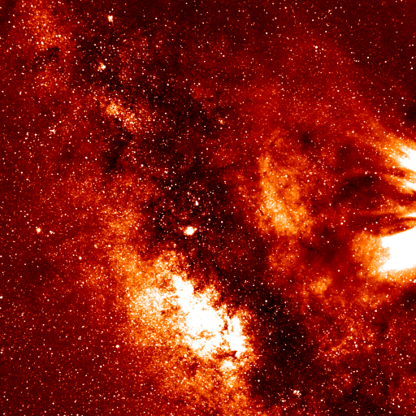
An image from STEREO’s remaining Heliospheric Imager shows a CME erupting from the Sun.
STEREO-A: Still Going Strong
Contact with the STEREO-B spacecraft was lost in 2014, eight years into the mission.
“We were of course very sad to lose contact with STEREO-B,” Dr Davies reflects. “But we have to remember, it had exceeded its planned lifespan by six years. We were very fortunate to have such a long period of dual-spacecraft operations.”
Fortunately, the mission didn’t end there, and STEREO-A continues to deliver high-quality data used daily for space weather monitoring.
“The remaining HI instrument is still performing incredibly well,” she says. “There’s hardly any degradation in the data. It’s a real credit to everyone involved in designing, building, and operating such a quality instrument.”
The team at RAL Space continue to provide post-launch support to STEREO’s remaining HI instrument through funding from the UK Space Agency.
A Legacy Beyond STEREO
RAL Space’s camera systems group also developed the CCD camera systems used across the spacecraft – expertise that later contributed to major missions including NASA’s Solar Dynamics Observatory, launched in 2010, the Solar UltraViolet Imagers On NOAA’s GOES-R series of operational satellites, and NASA’s PUNCH mission, launched in April 2025.
“The camera systems for STEREO presented some significant challenges. For example, finding various compact, space‑qualified, radiation-tolerant components was no easy task,” says Dr Nick Waltham, Camera Systems Programme Lead at RAL Space. “But the work we delivered for this mission shaped much of what followed. In many ways, it was a turning point for our team, and has underpinned many of our projects since.”
STEREO’s success has helped pave the way for a new generation of solar and space weather missions, including the European Space Agency’s Vigil, which will be Europe’s first 24/7 operational space weather satellite.
Since STEREO, RAL Space has continued to play a leading role in solar research missions, from Solar Orbiter to PUNCH, and is currently leading a UKSA-funded concept study for a UK-led space weather pathfinder mission (UK-ODESSI).