
UK-Singapore cubesat enters quantum experimentation phase
05 Aug 2026
Operational control of the SpeQtre cubesat has been transferred from RAL Space to Singaporean mission partner SpeQtral, marking the start of the mission’s quantum experimentation phase.

Why quantum communication matters
Satellite-based quantum communications are expected to play a critical role in enabling secure information transfer over distances that terrestrial fibre networks can’t practically cover. This comes at a time when the need for quantum-safe communications is growing, as advances in quantum computing threaten today’s widely used encryption standards.
Unlike conventional encryption, which relies on mathematical complexity that future quantum computers could eventually break, quantum communication uses the principles of quantum physics to distribute encryption keys using very weak light signals. Final keys are generated only from data that passes quantum security checks, providing strong privacy guarantees rooted in the laws of physics.
The technology is especially relevant for sensitive information including government communications, financial transactions, and sensitive data centre or cloud infrastructure traffic.
SpeQtre’s journey so far
Launched in November 2025, SpeQtre is a UK-Singapore collaboration aiming to demonstrate a super-secure form of quantum communication from space to ground, all from a satellite roughly the size of a microwave oven.
By scaling down this complex technology, the mission aims to reduce costs and improve accessibility for future quantum communication missions, despite the inherent technical difficulties involved.
Since launch, SpeQtre has been regularly detected and tracked during passes over optical ground stations in Singapore, operated by the Centre for Quantum Technologies at the National University of Singapore, and at the UK’s Chilbolton Observatory, operated by RAL Space. These sites have confirmed reception of the satellite beacon signal, while the satellite has also received uplink beacons from the ground.
Up until now, teams from RAL Space and platform provider ISISpace have been working hard to ensure that all the satellite’s systems are in working order in preparation for operational handover.
“Commissioning is a challenging process for any satellite, but preparing a mission as complex as SpeQtre takes that to another level,” explains Charles Whittington, Project Manager for SpeQtre at RAL Space. “We’ve overcome a number of challenges along the way to pointing the system accurately and repeatably, but each one has given our teams valuable experience. It’s a fantastic achievement to see that work pay off as we move into the beginning of science operations.”
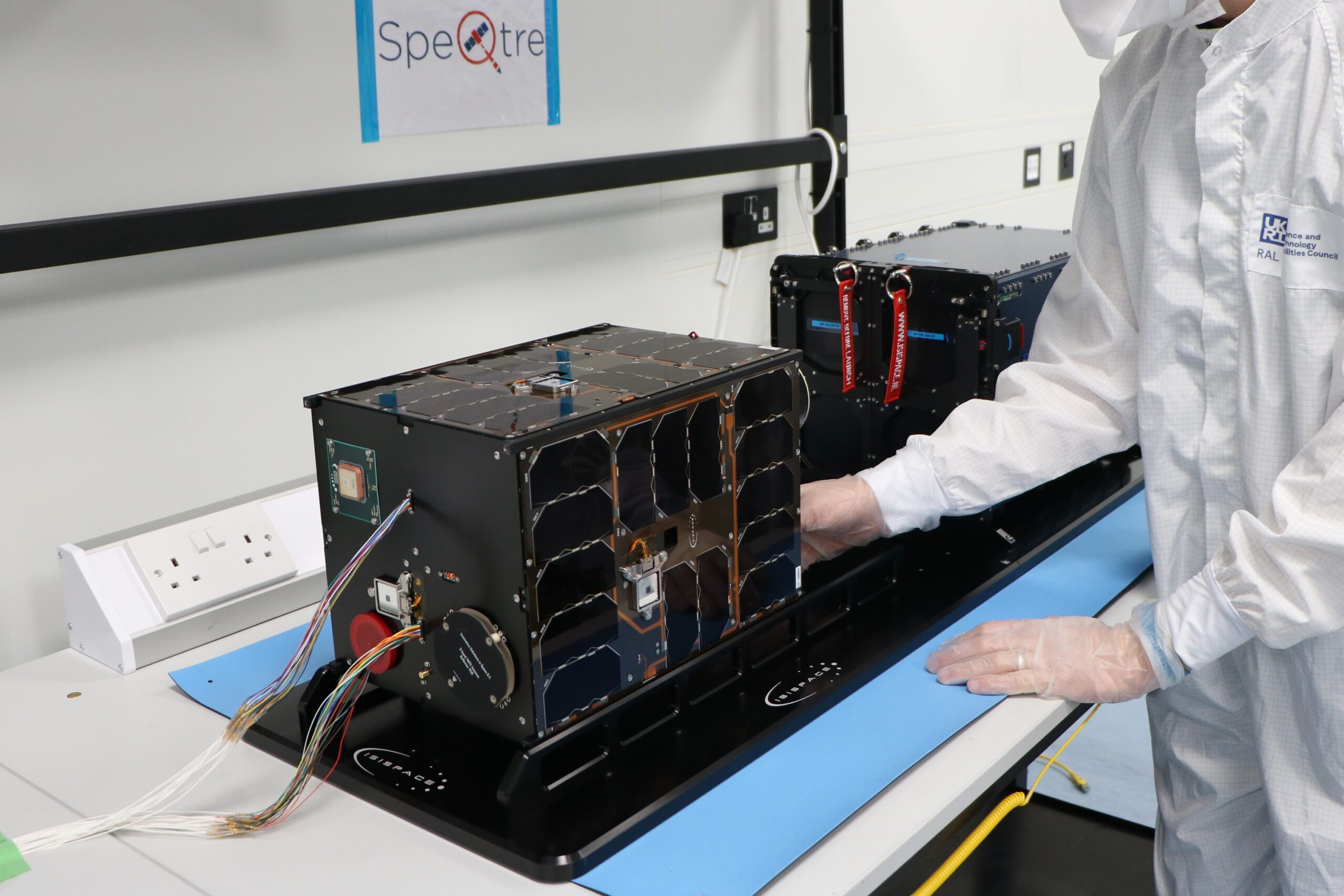
SpeQtre undergoing final preparations at RAL Space before being shipped for launch. Credit: STFC RAL Space

“We’ve overcome a number of challenges along the way to pointing the system accurately and repeatably, but each one has given our teams valuable experience. It’s a fantastic achievement to see that work pay off as we move into the beginning of science operations.”
Charles Whittington, SpeQtre Project Manager at RAL Space
Quantum experiments set to begin
With control of the satellite now handed over to mission partner SpeQtral, a quantum communications company based in Singapore, the teams are working through the technically demanding calibration process required to refine optical links with the precision needed for quantum communications. In parallel, SpeQtral is preparing the satellite’s onboard quantum source for operations, including calibration work to characterise and optimise its performance in space.
“For such a small satellite, an incredible amount of work has gone into SpeQtre so far”, says Andy Vick, Disruptive Space Technology lead at RAL Space and UK Principal Investigator for SpeQtre. “That’s not been unexpected. We knew from the outset that designing, building, and operating such an ambitious mission would be a challenge, and all our teams have already learned a huge amount all the way. We’re all pleased to see the satellite now handed over to our partners at SpeQtral, and wish them all the best as they begin science operations.”
“We knew from the outset that designing, building, and operating such an ambitious mission would be a challenge, and all our teams have already learned a huge amount all the way. We’re all pleased to see the satellite now handed over to our partners at SpeQtral, and wish them all the best as they begin science operations.”
Andy Vick, Disruptive Space Technology lead at RAL Space and UK Principal Investigator for SpeQtre
“Establishing and refining optical links between SpeQtre and ground stations is a foundational step in progressing space-based quantum communications,” said Chune Yang Lum, Co-founder and CEO of SpeQtral. “This is technically demanding work, and each stage gives us valuable operational learning as we continue to move quantum-secure communications closer to practical deployment.”
RAL Space is using the experience and knowledge gained from SpeQtre to address the UK’s Quantum Mission 2, which aims to deploy the world’s most advanced quantum network at scale by 2035. This initiative will network quantum processor clusters between advanced data centres to pave the way for a future quantum internet and secure digital infrastructure. Free space quantum communications via satellites is the key that will enable these networks to extend internationally to our friends and allies.
Related missions
RAL Space has also contributed to another recent quantum cubsat mission – the Satellite Platform for Optical Quantum Communications (SPOQC).
SPOQC is a UK-developed research collaboration bringing together the Universities of Bristol, Heriot-Watt, Strathclyde and York, alongside RAL Space. The mission also partnered with ISISPACE, which provided the satellite and overall technical support.
SPOQC launched in March 2026 and is currently undergoing its own commissioning phase, due to complete later this year.