The Small Satellite Calibration Facility (SSCF) is a newly commissioned national centre located at the Harwell Science and Innovation Campus in Oxfordshire. Developed through a collaboration between RAL Space (STFC) and the
National Physical Laboratory (NPL), the facility provides SI-traceable calibration services for instrumentation on small, cube, and nano satellites, covering the UV, visible, short-wave infrared (Vis-SWIR), and thermal infrared (TIR) spectral ranges.
The SSCF is designed to support UK and international start-ups and SMEs, offering rapid, affordable access to world-class calibration services. This lowers the barrier to entry for space missions and enhances the quality, reliability, and interoperability of Earth Observation (EO) data, supporting both commercial and scientific applications.
The facility builds on the proven calibration heritage of RAL Space and NPL, including work on missions such as CNES/UKSA MicroCarb and Copernicus Sentinel. It incorporates advanced systems such as:
- Thermal vacuum environment with motion control stages for precise alignment of the customers instrument with the calibration sources
- Collimator for geometric characterisation.
- Blackbody sources for TIR radiometric calibration.
- STARWELL system, based on NPL’s STAR-cc-OGSE, enabling radiometric calibration from 320 nm to 2500 nm using monochromatic and broadband sources.
The SSCF is part of the £200 million Earth Observation Investment Package from the Department for Science, Innovation and Technology (DSIT), reflecting the UK Government’s commitment to growing the space sector and delivering on the National Space Strategy.
Located within the vibrant Harwell Campus, which hosts over 100 space organisations including ESA, UKSA, Satellite Applications Catapult, and leading aerospace firms, the SSCF contributes to the UK’s ambition to become a global hub for trusted climate and Earth information services.
Space Calibration Cryostat – Vacuum environment
- Provides thermal vacuum environment for customer's instrument
Thermally controlled breadboard, design range -100°C to 80°C wider range possible please enquire. When instrument motion control stage fitted this limit the available temperature range.
Option to test in air and at room temperature.
Four 200mm diameter ports and two windows to view external calibration sources.
Thermally controlled breadboard
| Range -100°C to 80°C
|
|---|
Options
| In air and at room temperature testing
|
|---|
Ports
| 4 x 200mm plus 2 x windows to view external calibration sources
|
|---|
Instrument motion control
- Rotation stage with hexapod to position device under test allowing optical axis alignment while under vacuum and selection of calibration sources.
Hexapod for fine positioning repeatability of 3.2 µrad in rotation, and 0.4 µm in displacement
Rotation stage for source selection, repeatability 0.34 mrad.
Motion possible over temperature range -20 ⁰C to +50 ⁰C, with a bake capability of +75 ⁰C (no motion).
Hexapod repeatability
| 3.2 µrad in rotation, and 0.4 µm in displacement
|
|---|
Rotation stage for source selection
| Repeatability 0.34 mrad
|
|---|
Temperature range
| -20 ⁰C to +50 ⁰C, with a bake capability of +75 ⁰C (no motion)
|
|---|
Collimator – Geometric characterisation
- Image projection system with different targets for geometric characterisation of customer instruments Targets for MTF, PSD, MRTD characterisation. Custom targets available on request.
- 200mm aperture collimator system
- Vis/SWIR integrating sphere to illuminate object plane
- TIR Blackbody source operation from 0 to 125°C
- 0.5 to 20Hz chopper system

Blackbody – TIR radiometric calibration
- Temperature range 210K to 320K
- ITS-90 traceable source radiance uncertainty to better than 0.1K
- High emissivity ~0.998
- 200mm aperture - provision to stop target down with custom apertures.
- Heritage design, Based on ATSR/AATSR/SLSTR ground calibration targets - proven design with good performance
Temperature range
| 210K to 320K |
|---|
ITS-90 traceable source radiance uncertainty
| 0.04 – 2.10 W m-2 sr-1
|
|---|
High emissivity
| ~0.998
|
|---|
Aperture
| < 0.03nm
|
|---|

The SSCF also manages the traceable radiometric calibration in the UV-SWIR, initially using STAR-cc-OGSE which then led to the development of the new STARWELL facility.
STAR-cc-OGSE
Spectroscopically Tuneable Absolute Radiometric, calibration and characterisation, Optical Ground Support Equipment (STAR-cc-OGSE) was developed in partnership with the innovative company, M Squared. The STAR facility provides a state-of-the-art solution to instrument calibration and characterisation, ensuring the required performance is achieved while also minimising the time and effort involved in the pre-launch vacuum test environment.
The STAR facility was designed to meet the demanding needs of climate and environmental monitoring, and its flexibility, comprehensiveness and ease of use made it suitable for a wide range of applications. It enhances the performance of missions previously thought to be impossible due to cost and complexity, by providing end to end calibration and characterisation, and is able to be used by the cube-sats of new space providers. STAR-cc-OGSE is fully traceable to NPL’s primary radiometric standard, the cryogenic radiometer, and provides unprecedented uncertainties well below 0.5% across a wide spectral range.
MicroCarb, launched in 2025, was the first mission that used STAR-cc-OGSE. It is a joint mission between UKSA and CNES designed to measure sources and sinks of carbon, the principal greenhouse gas driving global warming.
STARWELL
Building on the knowledge gained from the development of SSCF’s STAR-cc-OGSE. STARWELL utilises much of the same science & engineering to enable quick turnaround, affordable access to radiometric calibration of small satellite payload instruments.
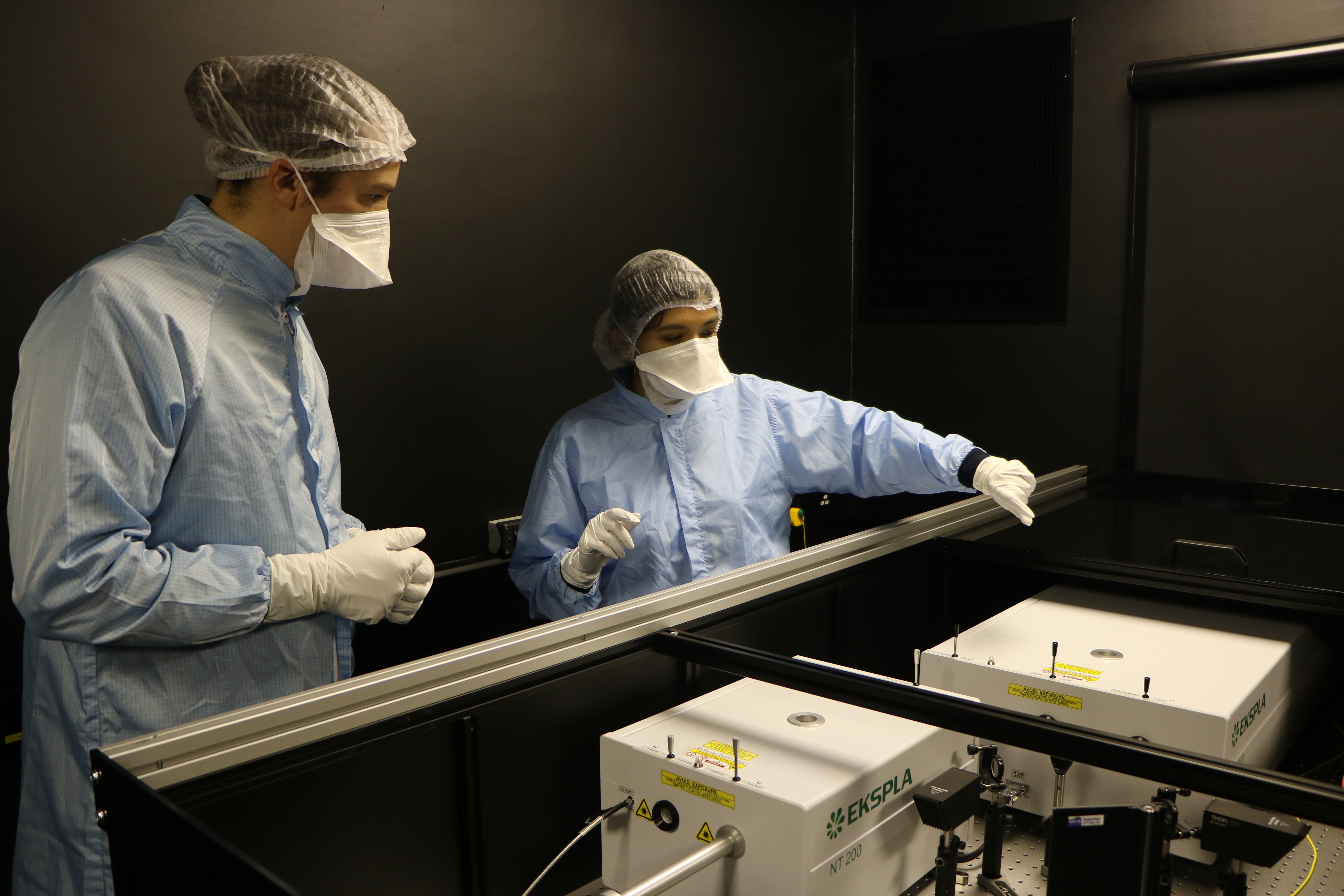
The STARWELL Facility at SSCF. Image credit: RAL Space STFC and NPL
The SSCF system combines the design of the radiometric calibration setup from STAR-cc-OGSE with a novel SI-traceable reference detector and a 1 kHz pulsed tuneable laser. This enables radiometric calibration measurements from 320 nm to 2500 nm with both monochromatic and broadband sources. The sequence of images below show how the SSCF can scan through the visible spectrum using monochromatic radiation.
 Image Credit: NPL
![]()
Small Satellite Calibration Facility offers a range of characterisations including:
- Absolute spectral response
- Linearity
- Polarisation sensitivity
- Spectral response function
- Stray light
- Spectral calibration
Small Satellite Calibration Facility Radiometric Specifications:
Monochromatic spectral range | |
| |
Monochromatic tuning resolution | |
Monochromatic wavelength accuracy | |
| 300 nm – 2500 nm @ TCCT = 3080 K |
| 2.0 W m-2 sr-1 nm(@1000 nm) |
Polarisation extinction ratio | |
Reference detector absolute radiance calibration uncertainty | |
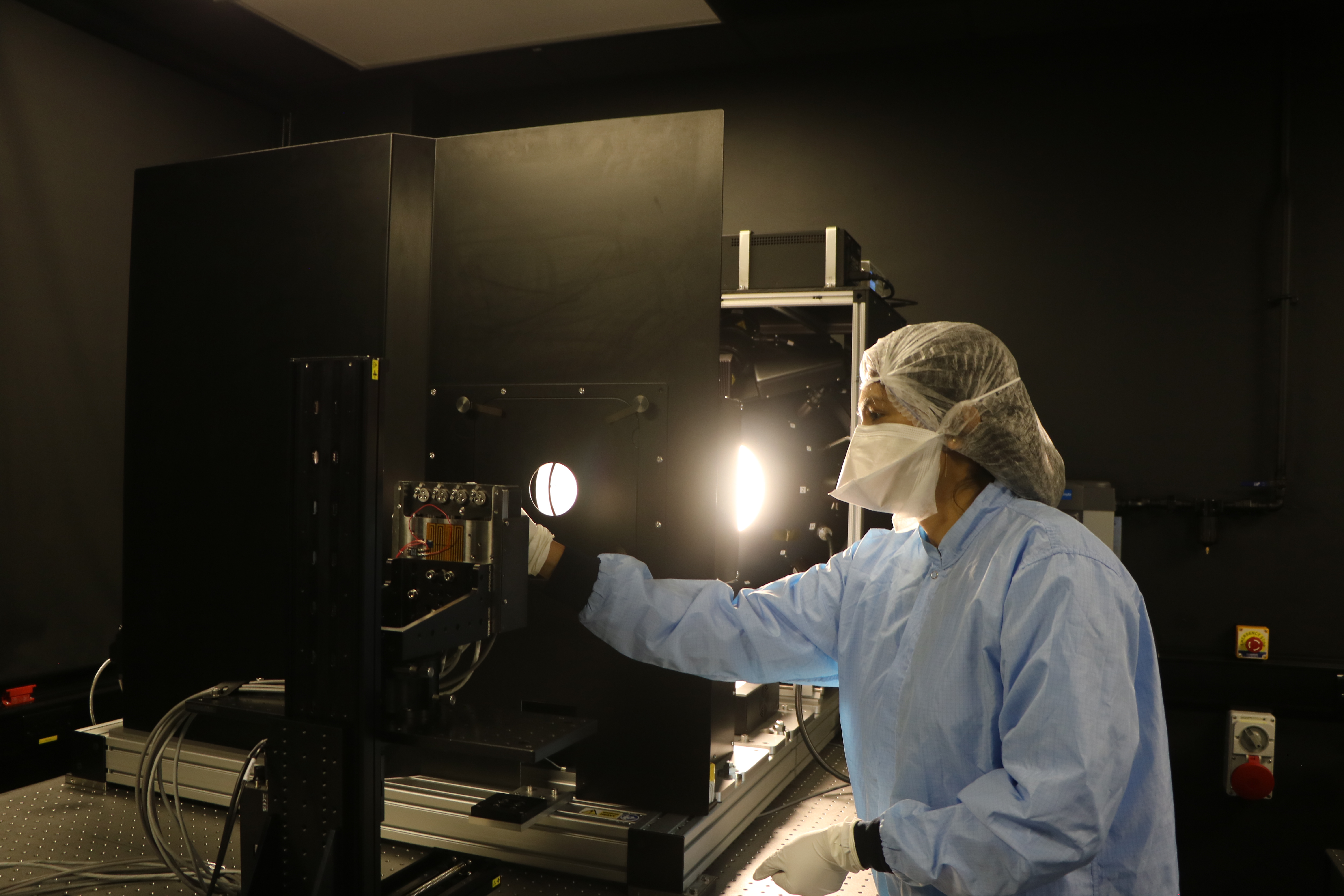
A member of the SSCF team setting up the STARWELL facility. Image credit RAL Space STFC and NPL.
For enquiries about the facility, please contact: sscfenquiriesralnpl@stfc.ac.uk Please note details sent to this inbox are received by both RAL Space and NPL.