While quantum computing promises breakthroughs in many areas, from medicine to finance, it also threatens to crack the encryption that currently protects everything from online banking to national security.
The UK government is backing quantum communication technology as the solution – using the unique properties of quantum particles to create encryption keys that cannot be intercepted without leaving a trace.
The SpeQtre satellite, a collaboration between the UK's Science and Technology Facilities Council (STFC) RAL Space and Singapore's SpeQtral, has launched from California on the SpaceX Transporter-15 rideshare mission.
The mission aims to demonstrate ultra-secure quantum communication technology from orbit – a crucial milestone in safeguarding data against cyber-attacks that could be enabled by next-generation quantum computers.
The UK contribution is funded by UK Research and Innovation through the National Quantum Technologies Programme.
SpeQtre aims to test communications so secure that any attempt to intercept them is instantly detectable – a fundamental law of physics that makes the technology unhackable even by future quantum computers.
It is a key step towards safeguarding data against potential cyber-attacks enabled by next-generation quantum computers.
Science and Technology Secretary Liz Kendall said:
"With cyber threats growing more sophisticated, there has never been a more important time to drive forward technologies that can keep us one step ahead of those threatening to wreak havoc.
"By drawing on the power of quantum technologies to keep data secure, this satellite demonstrates the value of British ingenuity in keeping our country safe from cyber threats while further building on our reputation as a world leader in quantum technology."
Reducing cost and accessibility
Establishing quantum communication links from space is an extremely complex feat, but one that is crucial for enabling secure, long-distance communication, across the world.
SpeQtre represents a notably more difficult technical challenge: demonstrating the exchange of quantum information from a cubesat roughly the size of a microwave oven.
By scaling down this complex technology, the mission aims to make future quantum communication systems more affordable and accessible – positioning Britain as a world leader in this emerging field.
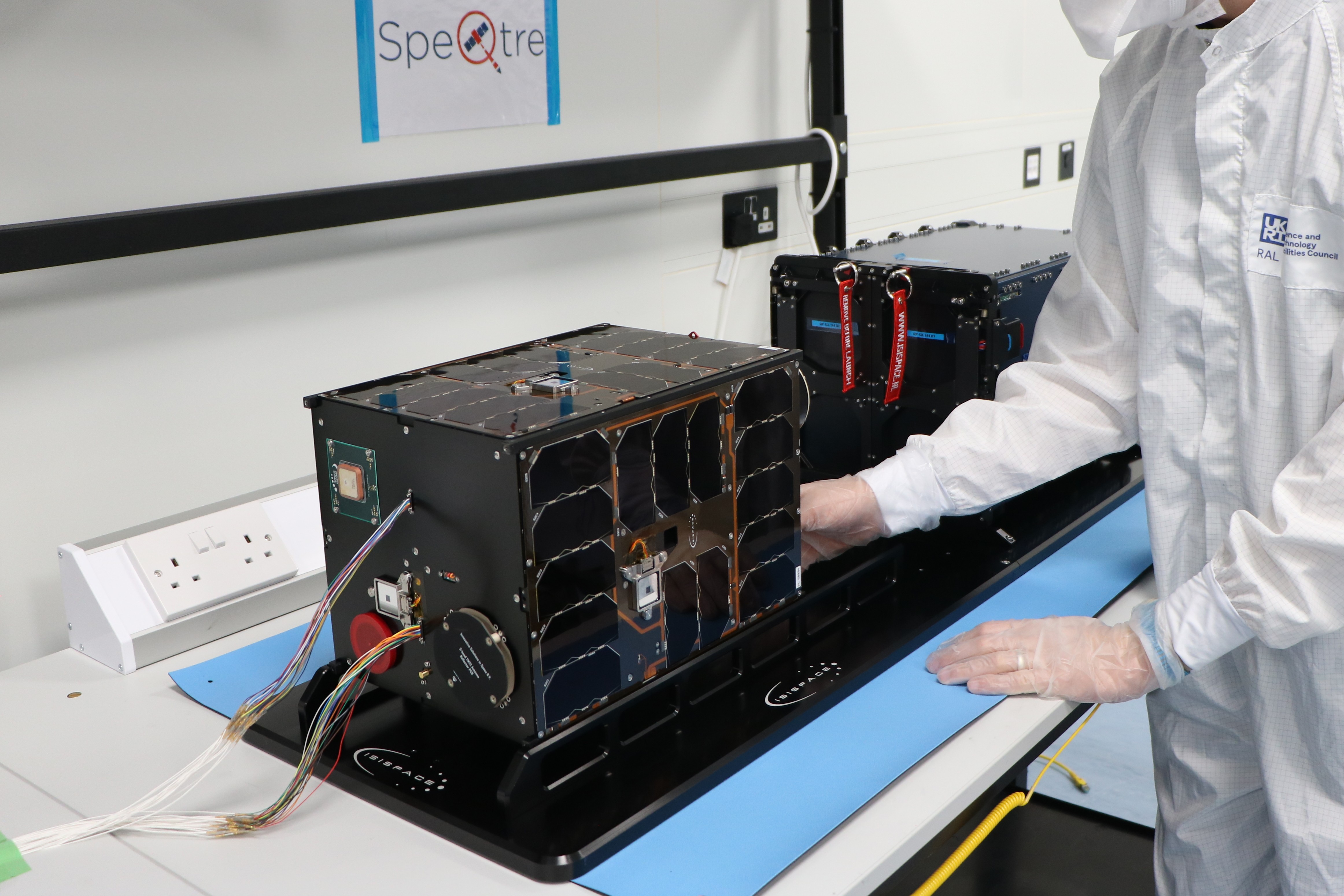
SpeQtre in the lab at RAL Space. Credit: STFC RAL Space
A different approach
The mission has taken a radically different approach from traditional space projects, combining off-the-shelf products with cutting-edge technology through an experimental development process.
This has enabled SpeQtre to progress from concept to orbit more quickly and at lower cost than comparable missions.
SpeQtre is already helping to shape the UK's future in quantum space research, informing the UK Quantum Networking Mission and upcoming initiatives such as SPOQC (Satellite Platform for Optical Quantum Communications), a related project led by the University of York under the EPSRC Quantum Communications Hub.
How quantum communication by satellite works
In classical encryption, users share strings of random numbers, called encryption keys, to encode and decode their messages.
While this system keeps information secure in most cases, it carries a vulnerability. If the key itself is intercepted during transmission, the entire communication can become compromised.
Quantum communication takes a very different approach. It encodes encryption keys within the quantum properties of particles. Because observing a quantum system changes its state, any attempt to eavesdrop will inevitably leave instantly detectable traces.
This fundamental law of physics means that quantum communication via satellite is, in theory, secure against all known forms of hacking, even those that could one day be carried out by powerful quantum computers.
UK-Singapore partnership
The UK's contribution to SpeQtre is led by STFC's RAL Space, the UK's national space laboratory. RAL Space is overseeing the mission's space components and developing the optical instrument that will beam quantum signals back to Earth.
Singapore's SpeQtral, a quantum communications company, is providing the quantum hardware, while the satellite platform is provided by ISISPACE.
SpeQtre stems from a UK-Singapore bilateral collaboration formed as part of a 2018 inter-governmental initiative to boost business and innovation between the two nations.
The project is part of the National Quantum Technologies Programme, managed by UK Research and Innovation, and is also supported by the Office for Space Technology & Industry, Singapore (OSTIn), Singapore's national space office.
Next steps
Following successful launch, the satellite will enter a commissioning phase during which the teams from RAL Space and SpeQtral will verify their systems are operating as expected. Quantum communication experiments are then scheduled to begin in early 2026.
SpeQtre aims to demonstrate its technology by exchanging quantum information between a RAL Space ground station at the Chilbolton Observatory in Hampshire and at the Centre for Quantum Technologies at the National University of Singapore. corresponding ground station in Singapore, providing crucial proof of concept for secure quantum communication from space.
Andy Vick, Disruptive Technology Lead at RAL Space and UK Principal Investigator for SpeQtre, said:
“SpeQtre is the first satellite developed through our agile mission facility, and a credit to the teams who have worked hard to deliver the payload for launch. By approaching this mission with speed and creativity, they have already paved the way for more ambitious missions ahead, including future UK demonstrators. But for now, for SpeQtre, the real fun begins as we look forward to the beginning of our quantum experiments in space."